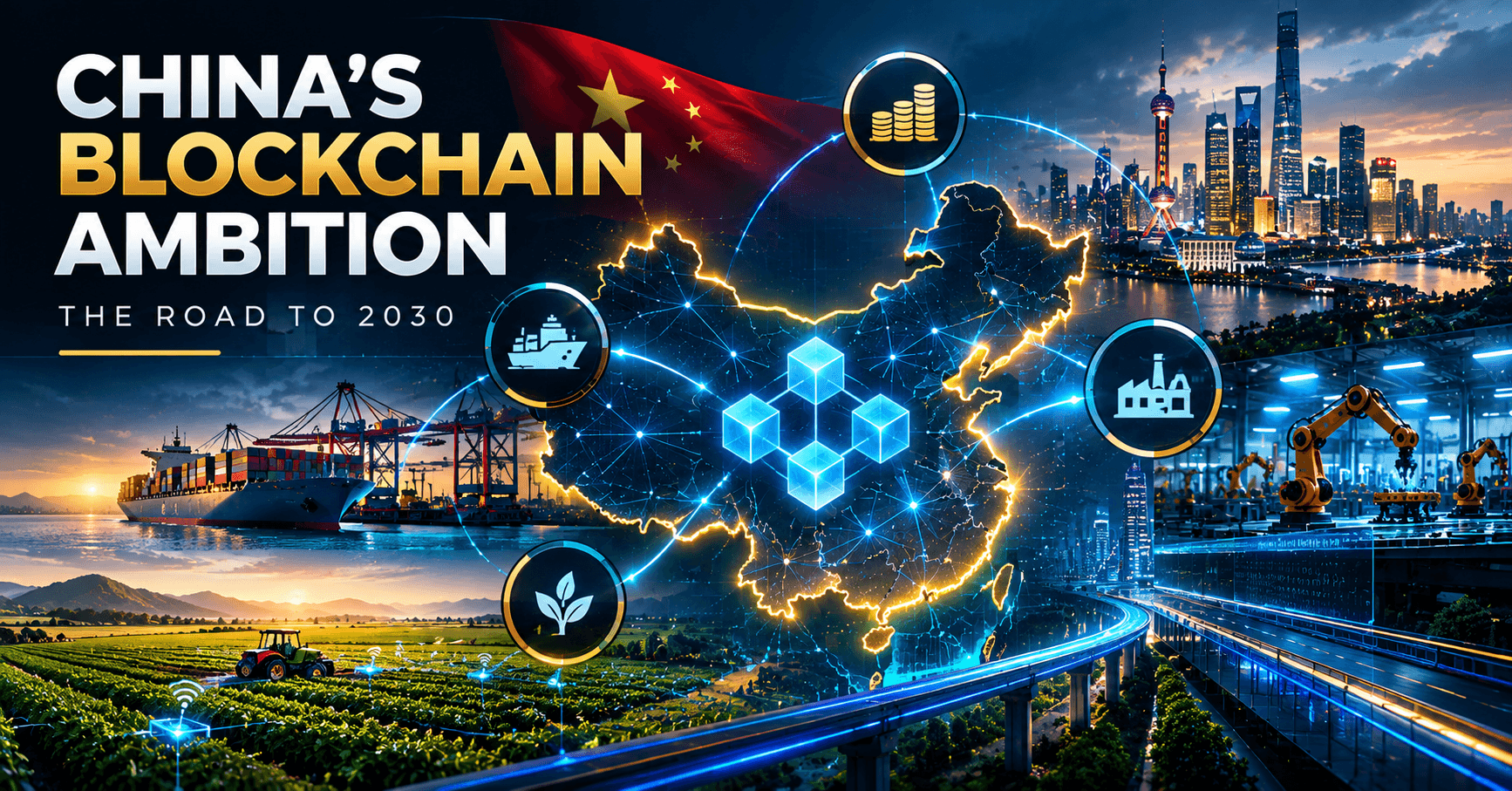
China has set a 2030 target for substantially completing its national blockchain network, placing distributed ledger technology among the country's long-term digital infrastructure priorities. The initiative forms part of a broader strategy to expand digital technologies across trade, finance, manufacturing, and agriculture.

The plan highlights an important distinction in the global blockchain industry: while public attention often focuses on cryptocurrency prices and token trading, governments and major economies are also exploring blockchain as infrastructure for business processes, data coordination, and digital services.
China's approach could provide further momentum for enterprise blockchain development. However, the announcement does not mean that China is endorsing decentralized cryptocurrencies or that every proposed application will achieve widespread adoption.
What Has China Announced?
China's latest national digital development planning includes a target of largely completing a national blockchain network by 2030. The initiative builds on earlier policy efforts to integrate blockchain into the country's digital economy.
According to reporting by Cointelegraph, the plan identifies several areas where blockchain infrastructure could be expanded, including trade and finance in the Yangtze River Delta and industrial applications in the Chengdu–Chongqing region.
The broader objective is to strengthen digital infrastructure and encourage the use of technologies that can support data sharing, verification, and coordination across organizations.
Importantly, the 2030 target represents a policy objective, not proof that the network is already complete or that all intended applications are operational. The scope, implementation milestones, and adoption of individual services will need to be evaluated as further details emerge.
Why Is a National Blockchain Network Important?
Blockchain technology allows multiple participants to share a record of transactions or other information under an agreed set of technical rules. Depending on the design, a network can provide shared verification, traceability, and a consistent history of recorded events.
These capabilities can be useful when several organizations need to coordinate information but do not necessarily operate within the same internal database or administrative system.
A national blockchain initiative could seek to provide common infrastructure, standards, or technical services for organizations across different industries.
However, the term "national blockchain network" does not necessarily describe one blockchain handling every transaction. It may refer to a broader ecosystem of infrastructure, interconnected systems, technical standards, and industry-specific applications.
The actual architecture and governance arrangements are therefore important. Without clear technical details, it would be premature to assume that every participating organization will use the same ledger or that all systems will be fully interconnected.
1. Trade and Finance Could Be Major Applications
International and domestic trade involve large volumes of documentation, including invoices, shipping records, product certifications, and payment information.
When different organizations maintain separate records, reconciling information can be slow and expensive. Blockchain-based systems may help participants verify selected records and track changes across a shared workflow.
Potential applications include:
- Supply-chain documentation: Recording selected events in the movement of goods.
- Trade finance: Coordinating verified documents between eligible businesses and financial institutions.
- Asset records: Maintaining auditable histories of selected digital or physical assets.
- Business verification: Helping authorized participants validate information exchanged across organizational boundaries.
These applications depend on the accuracy of the original information. Blockchain can help preserve and verify recorded data, but it cannot automatically establish that a document or claim entered into the system is truthful.
Legal recognition, data protection, integration with existing systems, and participation by businesses will also influence whether such solutions provide practical value.
2. Manufacturing Could Benefit From Better Data Coordination
Manufacturing networks often involve suppliers, factories, logistics providers, distributors, and customers. Each participant may need reliable information about components, production stages, quality checks, and delivery status.
A blockchain-based system could help authorized participants maintain a consistent record of selected events throughout a product's lifecycle.
For example, a manufacturer might record component certifications and inspection milestones so that downstream partners can verify relevant information without relying entirely on separate document exchanges.
Such a system could improve traceability and simplify some auditing processes. It would not eliminate the need for physical inspections, independent quality controls, or reliable data collection.
Integration costs are another consideration. Companies must evaluate whether a blockchain solution performs better than conventional databases or existing supply-chain software for their particular requirements.
3. Agriculture and Supply Chains Offer Additional Opportunities
Agricultural supply chains connect farms, processors, distributors, retailers, and consumers. Information about production, storage, transportation, and product origin can become fragmented as goods move between organizations.
Blockchain infrastructure could help record selected supply-chain events and make the resulting history available to authorized participants.
Possible applications include tracking the movement of agricultural products, recording quality-control events, and improving coordination between producers and buyers.
These systems could be particularly useful when several independent organizations need to verify the same information.
Nevertheless, digital traceability is only as reliable as the data entered into the system. If information is inaccurate at the point of collection, recording it on a blockchain does not make it accurate.
China's Blockchain Strategy Is Not the Same as Crypto Adoption
One of the most important points to understand is that blockchain technology and cryptocurrencies are related but distinct.
Blockchain is a method for maintaining and verifying shared records. Cryptocurrencies are digital assets that may operate on blockchain networks, but not every blockchain requires a publicly traded token.
Enterprise and government blockchain systems can use permissioned access, defined participation rules, and governance structures that differ significantly from open public networks.
China's national blockchain ambitions should therefore not be interpreted as an endorsement of Bitcoin, Ethereum, or unrestricted cryptocurrency trading.
Instead, the initiative reflects interest in blockchain as a component of digital infrastructure and economic modernization.
This distinction matters for investors and developers. Government investment in blockchain technology does not automatically create demand for any particular cryptocurrency or guarantee appreciation in the price of a related token.
How Could the Plan Affect the Global Blockchain Industry?
China's target adds to the broader international competition to develop digital infrastructure and practical blockchain applications.
Different countries and organizations are exploring ways to use distributed ledgers for financial services, trade documentation, identity-related systems, supply-chain management, and tokenized assets.
A large-scale national initiative could encourage additional research, investment, and enterprise development. It may also increase attention on interoperability, technical standards, data governance, and the relationship between public and permissioned blockchain networks.
However, the global impact will depend on implementation rather than the announcement alone.
Several factors will matter:
- Real-world adoption: Whether businesses and institutions actively use the systems being developed.
- Interoperability: Whether different platforms can exchange information securely and reliably.
- Governance: How participation, access, data management, and dispute resolution are handled.
- Economic value: Whether blockchain-based processes reduce costs, improve verification, or deliver benefits that justify implementation.
- International compatibility: Whether systems can work with standards and services used by organizations in other jurisdictions.
These factors will help determine whether the initiative becomes an influential model for enterprise blockchain infrastructure or remains primarily a collection of national and industry-specific systems.
What Does This Mean for Developers and Businesses?
For blockchain developers, enterprise adoption creates opportunities beyond launching tokens or building decentralized trading applications.
Businesses may need software that connects existing databases with blockchain systems, verifies digital records, manages permissions, and presents complex information through practical interfaces.
Developers working in supply-chain technology, financial software, digital identity, compliance systems, and enterprise integration may therefore find relevant opportunities as organizations explore distributed ledger infrastructure.
Businesses considering blockchain should begin with a specific operational problem rather than adopting the technology simply because it is receiving attention.
Questions worth asking include:
- Do several independent organizations need to share or verify the same records?
- Would a shared ledger offer meaningful advantages over a conventional database?
- Who will control access and correct inaccurate information?
- How will the system integrate with existing software and legal requirements?
- Can the expected benefits justify the cost of development and maintenance?
Answering these questions can help organizations distinguish practical blockchain opportunities from projects that add complexity without delivering measurable value.
Challenges China Will Need to Address
Building national-scale digital infrastructure involves more than deploying software. Long-term success depends on technical reliability, institutional cooperation, security, governance, and sustainable use.
Several challenges may influence the implementation of China's blockchain plan.
Interoperability: Different industries may develop systems with different technical requirements. Connecting them reliably can be difficult.
Data quality: Distributed ledgers preserve recorded information, but they cannot independently guarantee that the original data is correct.
Privacy and access: Organizations must determine which information can be shared, who can access it, and how sensitive records should be protected.
Integration costs: Existing businesses may need to adapt legacy software, operational procedures, and data-management systems.
Demonstrable value: The long-term case for blockchain depends on measurable benefits rather than the technology's reputation alone.
The 2030 target provides a timeframe for development, but actual progress will need to be assessed through concrete deployments, technical milestones, and evidence of sustained adoption.
Conclusion: Blockchain Development Is Moving Beyond Cryptocurrency Prices
China's 2030 target for its national blockchain network highlights the growing role of distributed ledger technology in discussions about digital infrastructure and industrial modernization.
Trade, finance, manufacturing, and agriculture are potential areas of application because they involve multiple organizations that need reliable ways to exchange and verify information.
At the same time, a government-backed blockchain initiative is not the same as support for decentralized cryptocurrencies, and the announcement does not guarantee success for every proposed application.
The more important measure will be whether the systems deliver practical benefits, gain participation, and integrate effectively with existing economic processes.
For the global blockchain industry, the development is another reason to look beyond daily token prices and examine where distributed ledger technology is being applied to real operational problems.
Disclaimer: This article is for informational and educational purposes only. It does not constitute financial, investment, or legal advice. Statements about future implementation describe policy objectives and potential applications, not guaranteed outcomes.
Sources and Further Reading
```Get Breaking AI & Crypto Briefings First on Telegram
Join our real-time intelligence channels for daily AI breakthroughs, on-chain data signals, and market analysis.
Related Articles
 Blockchain
Sony-Backed Soneium Plans New Crypto Token to Connect AI, Blockchain, and Entertainment
Sony-backed blockchain network Soneium plans to introduce its native SONEIUM token while expanding tokenized intellectual property...
 Blockchain
Enterprise Adoption and Compliance: Interoperability in Decentralized Identity Wallets
Explore how interoperability in decentralized identity wallets is shaping enterprise adoption and compliance in 2026.
 Blockchain
How Interoperability in Decentralized Identity Wallets Shapes 2026 Compliance
Explore how interoperability in decentralized identity wallets is crucial for compliance, enterprise adoption, and privacy in 2026...