Table of contents
Bitcoin Falls Below $80,000: ETF Outflows and Liquidations Put Crypto Markets on Alert
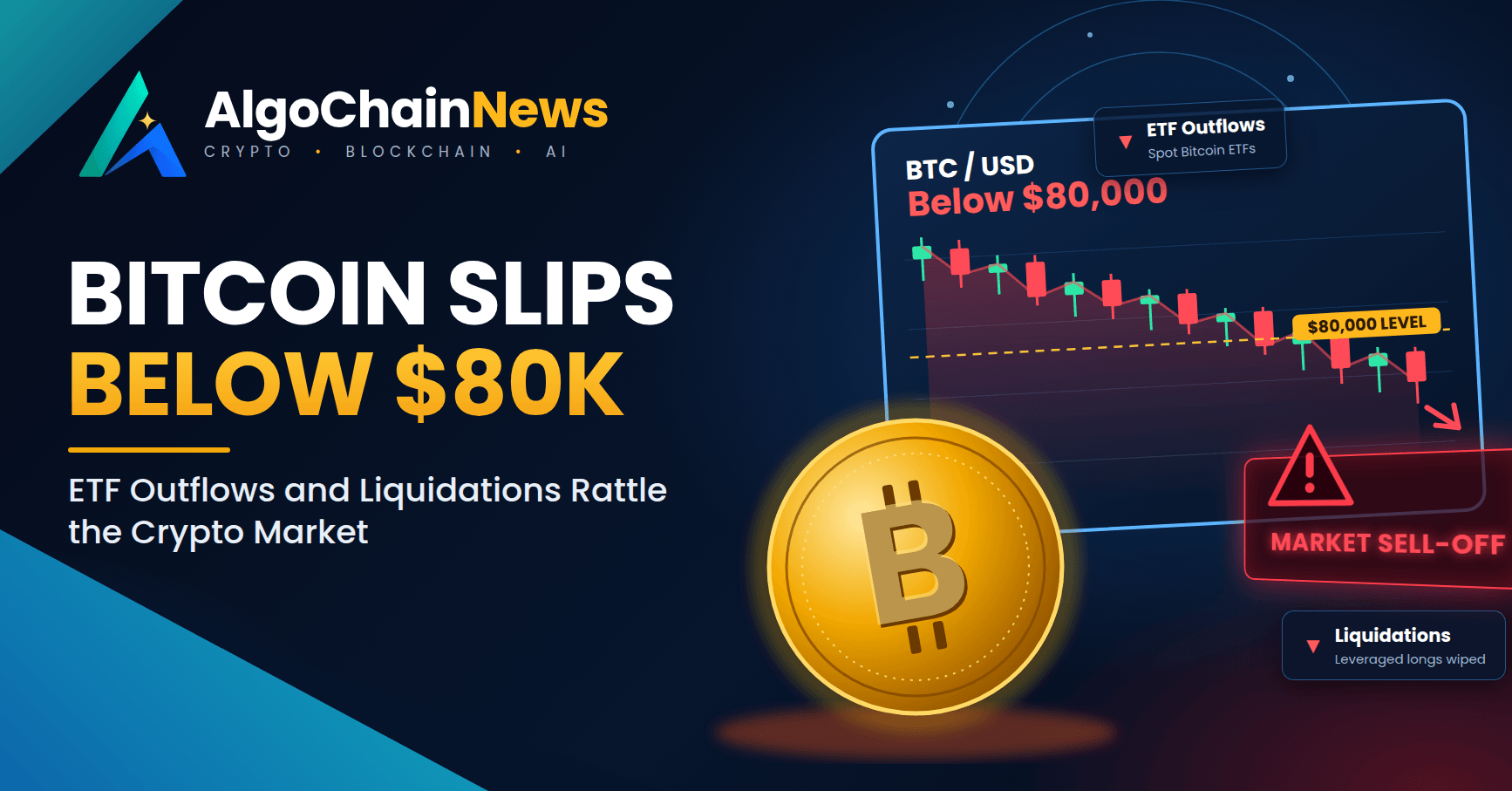
Bitcoin is facing renewed selling pressure as cryptocurrency markets enter the final week of October. The world's largest cryptocurrency briefly slipped below the psychologically important $80,000 level, intensifying concerns among traders already watching institutional fund flows, derivatives activity, and broader financial-market uncertainty.

The latest decline highlights a challenge facing crypto investors: Bitcoin can attract substantial institutional interest during a rally, yet still experience sharp reversals when market sentiment weakens and leveraged positions begin to unwind.
For traders and long-term holders, the central question is whether the latest move represents a temporary correction or the beginning of a more sustained period of weakness.
Bitcoin Tests the $80,000 Psychological Level
The $80,000 level has become an important reference point for market participants. Round-number price levels often influence trading decisions because traders use them to place orders, manage risk, and evaluate market momentum.
Bitcoin's brief move below this threshold has therefore attracted attention beyond the immediate price decline.
However, a break below a psychological level does not automatically confirm a longer-term bearish trend. Traders typically look for additional evidence, including whether BTC can recover the level, how trading volume develops, and whether selling pressure continues during subsequent sessions.
A sustained recovery above $80,000 could help restore short-term confidence. Continued trading below the level, particularly alongside weaker market breadth, could increase the risk of further volatility.
Investors should distinguish between a brief price dip and a confirmed breakdown supported by broader market data.
Why Is Bitcoin Under Pressure?
Several factors may be contributing to the current weakness, including institutional fund flows, leveraged trading positions, and uncertainty across global financial markets.
1. Bitcoin ETF Outflows
Spot Bitcoin exchange-traded funds (ETFs) have become an important channel through which traditional investors gain exposure to BTC.
Recent market reports indicated that US spot Bitcoin ETFs recorded approximately $635.6 million in net outflows on October 22, 2026. This figure should be verified against the original ETF flow data before publication.
ETF outflows do not necessarily mean that every investor has lost confidence in Bitcoin. Investors may reduce exposure for several reasons, including portfolio rebalancing, profit-taking, or changing expectations about interest rates and economic growth.
Nevertheless, sustained net outflows can weaken a source of institutional demand and become an important indicator of investor sentiment.
The next several trading sessions may provide a clearer picture of whether the withdrawals represent a temporary reaction to market volatility or a broader reduction in Bitcoin exposure.
2. Leveraged Positions Increase Market Sensitivity
Leverage can amplify both gains and losses in cryptocurrency markets.
When traders borrow funds or use derivatives to establish positions larger than their available capital, even a relatively modest price decline can trigger forced liquidations.
These liquidations may create additional selling pressure, pushing prices lower and potentially triggering further liquidations. This process can accelerate market moves in either direction.
Reports of elevated long-position liquidations during the latest decline suggest that leveraged bullish traders may have been particularly exposed to the pullback. Current liquidation figures should be checked against reliable derivatives data before publication.
Liquidation figures should also be interpreted carefully. They measure positions forcibly closed by exchanges, not necessarily the total amount of new spot-market selling.
For traders, the practical lesson is that leverage can turn an ordinary correction into a much sharper move.
3. Global Financial Markets Affect Crypto Sentiment
Bitcoin is often discussed as an alternative financial asset, but its short-term performance can still be influenced by developments in traditional markets.
Weakness in technology stocks, concerns about artificial-intelligence spending, geopolitical uncertainty, and interest-rate expectations can contribute to a more cautious environment for risk assets.
When investors reduce exposure to volatile investments, cryptocurrencies can experience selling pressure alongside technology equities.
This relationship is not constant, and Bitcoin does not always move in the same direction as stocks. However, periods of broad risk aversion can affect crypto prices even when there is no major negative development within the blockchain industry itself.
That makes macroeconomic conditions an important part of the market picture.
What Should Traders Watch Next?
Rather than attempting to predict the next price move from a single headline, market participants can monitor several indicators.
- Bitcoin's ability to recover $80,000: A sustained move above the level may indicate that buyers are returning. Repeated failures to reclaim it could signal continued weakness.
- Spot Bitcoin ETF flows: Several consecutive sessions of net inflows could suggest that institutional demand is stabilizing. Continued outflows would indicate that selling pressure remains a concern.
- Derivatives liquidations and open interest: Large liquidations can contribute to short-term volatility. Changes in open interest may help traders assess whether speculative positions are being reduced or rebuilt.
- Trading volume: A price move accompanied by unusually high volume may carry more significance than a similar move during quieter trading conditions.
- Broader financial markets: Technology-stock performance, interest-rate expectations, and geopolitical developments may influence investors' willingness to hold risk-sensitive assets.
No single indicator provides a reliable forecast. The strongest analysis considers several signals together and acknowledges when the available evidence remains inconclusive.
Could Bitcoin Recover From the Decline?
A recovery remains possible, but it should not be treated as guaranteed.
Bitcoin could stabilize if selling pressure eases, ETF flows improve, and buyers return around important price levels. A reduction in leveraged positions could also make the market less vulnerable to forced selling.
On the other hand, persistent fund outflows, continued weakness in global risk assets, or another wave of liquidations could place additional pressure on prices.
It is important to distinguish between a short-term rebound and a genuine change in trend. A rapid recovery after a sell-off does not necessarily mean that the underlying market structure has strengthened.
Investors evaluating the situation should consider their time horizon, exposure to volatility, and ability to withstand further losses.
What Does This Mean for Long-Term Bitcoin Investors?
For long-term investors, the latest decline is a reminder that Bitcoin remains a volatile asset, even as institutional investment products and regulated market infrastructure become more established.
Short-term price movements can be influenced by liquidity, derivatives positioning, investor sentiment, and macroeconomic developments. These factors may create substantial price swings without necessarily resolving the longer-term debate about Bitcoin's role in digital finance.
However, long-term conviction should not be confused with ignoring risk.
Investors should avoid committing money they cannot afford to lose, relying on borrowed funds to maintain positions, or assuming that a particular price level must hold.
A disciplined approach can include setting clear allocation limits, maintaining sufficient liquidity, and reviewing whether an investment still fits one's financial objectives.
The Bigger Picture: Volatility Remains Central to Crypto Markets
Bitcoin's move below $80,000 demonstrates how quickly sentiment can change when several pressures emerge at the same time.
ETF outflows may weaken demand, leveraged liquidations can accelerate price movements, and uncertainty in traditional financial markets can reduce appetite for speculative assets.
At the same time, one sharp decline does not establish the direction of the market for the remainder of the year.
The coming sessions will be important for determining whether Bitcoin can regain stability or whether selling pressure continues.
For now, investors should focus on verifiable market data, avoid treating short-term price levels as certainties, and manage risk carefully in a market where conditions can change rapidly.
Sources and Further Reading
- The Block — Cryptocurrency market news and analysis.
- Business Today Malaysia — Financial and cryptocurrency market coverage.
Disclaimer: This article is for informational and educational purposes only. It does not constitute financial or investment advice. Cryptocurrency markets are highly volatile, and readers should conduct their own research before making financial decisions.
```Related Articles
 Market Analysis
Analyzing Crypto Market Liquidity Signals After Exchange Policy Changes
This article examines the impact of recent exchange policy changes on crypto market liquidity signals, focusing on trader implicat...
 Market Analysis
Utilizing On-Chain Indicators for Market Analysis in 2026
Explore how on-chain indicators can enhance market analysis for traders and builders in 2026.
 Market Analysis
Assessing Crypto Market Liquidity Signals Amidst Recent Technological Advancements
This article delves into the evolving landscape of crypto market liquidity signals, focusing on the impact of technological advanc...