
Table of contents
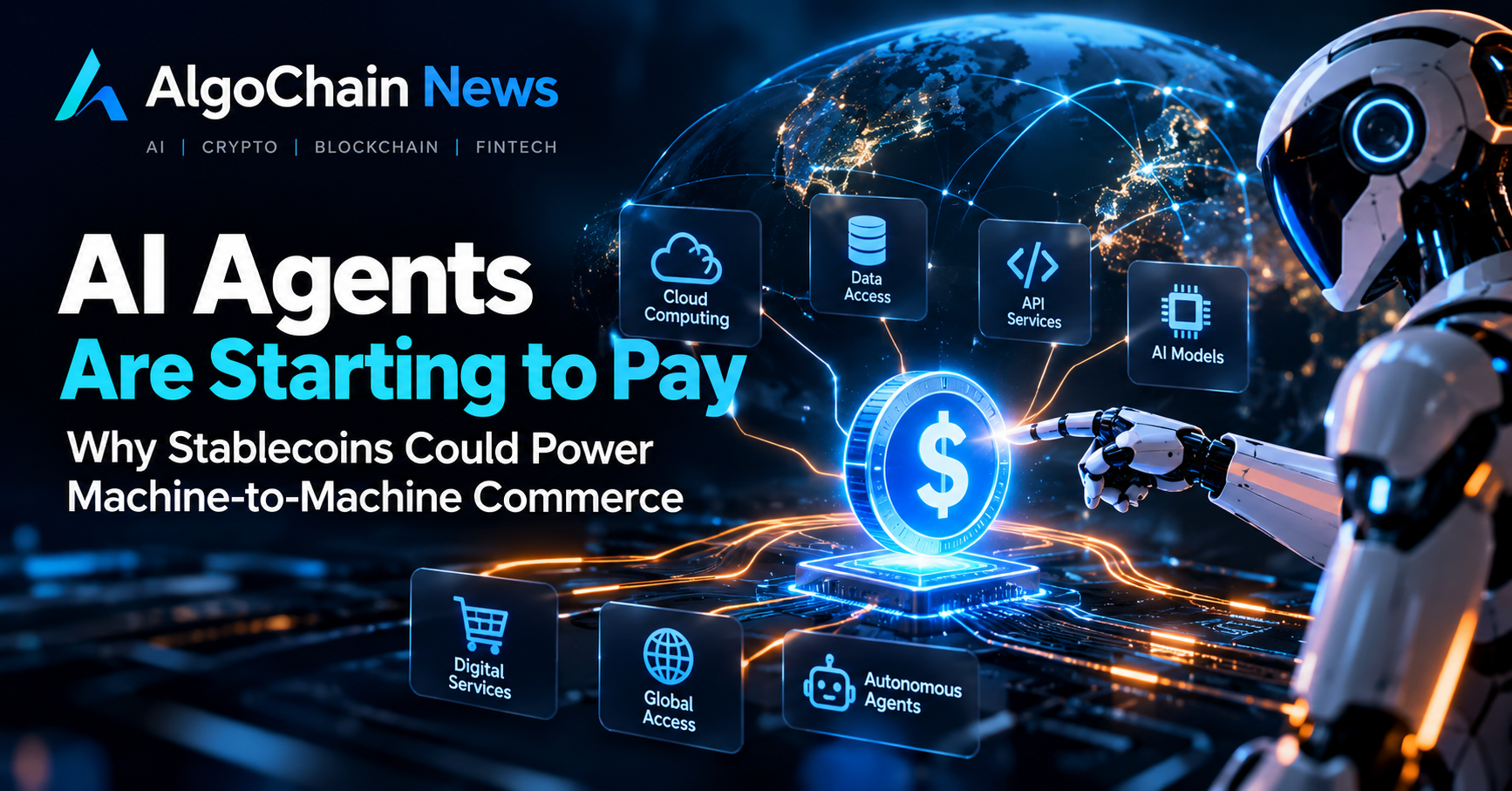
AI agents are moving beyond answering questions and generating content. As autonomous software begins purchasing data, computing power and digital services, a new payments market is emerging — and stablecoins could become an important part of its financial infrastructure.

Artificial intelligence is entering a new phase.
The first wave of generative AI was primarily about producing information: answering questions, writing text, generating images and assisting users with decisions. The emerging generation of AI agents is designed to do something more consequential — take actions on behalf of users and businesses.
That can include booking services, purchasing digital resources, calling paid APIs, acquiring computing capacity, managing procurement or coordinating with other software agents.
Once software can independently initiate transactions, however, it needs payment infrastructure capable of operating at machine speed.
This is creating a new intersection between artificial intelligence, fintech, blockchain and digital payments. Stablecoins may become an important part of that intersection.
From AI Assistants to Economic Agents
Most online payments today assume that a human is somewhere in the transaction.
A customer opens a checkout page, enters or selects payment information, approves a purchase and receives a product or service. Autonomous AI could change that model.
Imagine a company giving an AI procurement agent a budget and instructing it to continuously find efficient cloud computing resources. The agent could compare providers, purchase additional capacity when required and reduce spending when demand falls — while operating within predefined permissions and spending limits.
Another AI system might independently purchase:
- access to a specialized dataset;
- individual API requests;
- GPU or cloud computing capacity;
- translation or analytical services;
- access to premium research;
- digital storage; or
- services provided by another AI agent.
Many of these transactions could be extremely small. Instead of purchasing one large monthly subscription, an autonomous system might execute hundreds or thousands of low-value transactions as resources are consumed.
This is no longer purely theoretical. In June 2026, Mastercard announced Agent Pay for Machines, describing infrastructure designed for continuous, high-frequency and low-value transactions initiated by agents and machines.
Why Traditional Payments Face a Machine-Commerce Challenge
Credit cards, bank transfers and conventional payment systems were primarily designed around transactions involving people and businesses. Machine-to-machine commerce can behave differently.
Programmatic Transactions
Payments may need to be initiated directly by software without requiring a human to complete a conventional checkout process every time.
Continuous Activity
AI agents can operate around the clock. They may purchase resources whenever required rather than during a traditional shopping session.
Low-Value Payments
Individual transactions may be worth only a few cents — or potentially even less — depending on the service being purchased.
High Transaction Frequency
One autonomous workflow could potentially generate hundreds or thousands of individual transactions.
Global Accessibility
Digital agents may interact with service providers operating across multiple countries, platforms and financial systems.
Mastercard says machine payments can involve fundamentally different transaction patterns, including very high volumes, very small values and low-latency execution. Its Agent Pay for Machines service is designed specifically around this emerging model.
Why Stablecoins Could Fit the Model
Stablecoins combine characteristics of blockchain-based digital assets with a relatively stable unit of account.
Unlike highly volatile crypto assets, fiat-backed stablecoins are generally designed to track currencies such as the U.S. dollar.
For autonomous systems, that distinction matters.
An AI agent purchasing a small amount of data or computing power may need a predictable unit of account rather than exposure to an asset whose market value can change significantly.
Stablecoins potentially provide several characteristics useful for machine commerce.
1. Programmability
Stablecoin transactions can be initiated through software and integrated directly into automated workflows, applications and smart contracts.
2. Always-On Infrastructure
Public blockchain networks generally operate continuously rather than according to conventional banking hours, allowing compatible systems to initiate transactions around the clock.
3. Support for Small Digital Payments
Depending on the blockchain, fees and payment architecture involved, digital asset infrastructure can support relatively small payments suitable for pay-per-use services.
4. Internet-Native Payments
Wallets, APIs and blockchain transactions can be integrated directly into software, potentially reducing the need for traditional human-oriented checkout interfaces in machine-to-machine transactions.
5. Composability
Payments can interact with APIs, smart contracts and other programmable infrastructure, creating new possibilities for automated commerce.
Major payment networks are also exploring this convergence. At its 2026 Payments Forum, Visa announced new AI, stablecoin and token capabilities, including expansion of stablecoin settlement initiatives and infrastructure for agentic commerce.
Agentic Payment Infrastructure Is Already Emerging
The idea of AI agents making payments is rapidly moving from experimentation toward infrastructure development.
Visa describes Visa Intelligent Commerce as infrastructure intended to help AI agents securely discover, initiate and complete transactions while maintaining controls and trust between participants.
In June 2026, Visa also announced a collaboration with OpenAI focused on enabling secure Visa payments in agentic-commerce environments. According to Visa, the system is intended to operate with defined user permissions and controls such as spending limits, merchant categories and required approvals.
Mastercard is approaching the same emerging market from another direction.
Its Agent Pay for Machines infrastructure is designed to allow verified agents to operate within predefined permissions and execute high-frequency machine transactions. Mastercard says settlement can occur through multiple payment types, including cards, accounts and stablecoins.
Together, these developments suggest that agentic commerce may not belong exclusively to either traditional finance or blockchain. Instead, the emerging infrastructure could combine both.
x402: Building Payments Into the Web
Blockchain-native infrastructure is targeting another important part of machine commerce: direct software-to-software payments.
One notable example is x402.
Coinbase introduced x402 as an open payment standard that uses the HTTP 402 Payment Required status code to enable stablecoin payments directly through web interactions.
The basic concept is straightforward.
- An AI agent or application requests a digital resource.
- The server responds with a
402 Payment Requiredmessage containing payment requirements. - The client prepares the required payment.
- The request is submitted again with payment information.
- The payment is verified and settled.
- The requested resource is returned to the client.
In practical terms, this could allow software to pay directly for an API call, dataset or digital service without first navigating a conventional subscription or checkout process.
Coinbase specifically identifies paid APIs, metered services and autonomous AI-agent transactions among potential x402 use cases.
The Internet Could Shift Toward Pay-Per-Use Services
Today's internet economy relies heavily on subscriptions.
Consumers subscribe to streaming platforms. Businesses subscribe to software. Developers purchase API plans. Organizations pay recurring fees for databases and cloud services.
Autonomous software may make another economic model more practical: pay per use.
Consider an AI research agent that needs information from dozens of specialized databases.
A company might traditionally purchase subscriptions to several of those databases. An autonomous agent could instead pay only for the specific information required for a particular task.
One database query might cost a fraction of a dollar. Another service could charge for a specialized analysis. Computing resources could be purchased only for the seconds or minutes during which they are required.
The agent could then select providers dynamically according to price, quality, latency, reliability and its owner's predefined rules.
This does not necessarily mean subscriptions will disappear. Instead, machine commerce could make usage-based pricing economically practical for a much broader range of digital services.
AI Agents Could Become a New Type of Customer
This development could also change how digital businesses think about customers.
Today, websites and applications are optimized primarily for humans. In an agentic economy, businesses may increasingly serve two broad categories of customers:
- Human customers who interact through websites, applications and conventional interfaces.
- Machine customers that interact through APIs, protocols and automated payment systems.
A data company, for example, could expose datasets that AI agents automatically discover and purchase.
A developer could create a specialized digital service that other AI agents use whenever they need a particular task performed.
Cloud computing resources could be purchased dynamically. Research could be sold by the query. Digital content could be licensed individually. Specialized AI models could charge according to actual usage.
In this environment, an AI agent effectively becomes a programmable economic participant operating within the permissions established by its owner.
Identity May Be as Important as Payments
Giving autonomous software the ability to spend money creates an important question:
How does a merchant know that an AI agent is legitimate and authorized to make a purchase?
Payments alone do not solve this problem.
Agentic commerce may require infrastructure capable of establishing:
- who or what organization controls an agent;
- what the agent is authorized to purchase;
- how much the agent can spend;
- which merchants or services it can interact with;
- how transactions can be audited;
- how credentials can be revoked; and
- what happens when an agent makes an incorrect or unauthorized purchase.
Visa's work illustrates the importance of this issue. Its Trusted Agent Protocol is designed to help merchants distinguish legitimate AI agents from potentially malicious bots and establish trust during agent-driven transactions.
The infrastructure required for machine commerce may therefore involve much more than moving money. It may need to combine identity, authorization, payments, settlement and auditability.
Security Becomes a Major Challenge
Autonomous payments also introduce new security risks.
If an AI assistant produces an incorrect answer, the result may simply be inconvenient. If an autonomous financial agent misinterprets an instruction, has its credentials compromised or is manipulated into making unauthorized transactions, the consequences could involve real financial losses.
Businesses deploying payment-enabled agents will therefore need strong controls.
Potential safeguards could include:
- daily and per-transaction spending limits;
- approved merchant categories or lists;
- transaction monitoring;
- secure credentials;
- risk-based authorization;
- human approval above defined thresholds; and
- mechanisms to immediately suspend an agent's payment authority.
These controls are already appearing in emerging systems. Visa says its agentic-payment work includes user-defined permissions and spending controls, while Mastercard describes permissioning and spending limits as foundational components of Agent Pay for Machines.
This is particularly important because autonomous agents can operate much faster than humans. Automation can increase efficiency, but without appropriate safeguards it can also increase the speed at which errors or malicious activity propagate.
Traditional Finance and Blockchain May Converge
It would be overly simplistic to frame the emerging market as stablecoins versus banks or blockchain versus card networks.
The infrastructure now being developed points toward convergence.
Traditional payment networks are adding capabilities designed for AI agents. Stablecoin settlement is expanding. Blockchain companies are developing programmable payment protocols. Meanwhile, payment providers are building infrastructure that can operate across multiple payment rails.
Mastercard's Agent Pay for Machines, for example, explicitly supports settlement across cards, accounts and stablecoins. Visa is simultaneously investing in AI-driven commerce and expanding stablecoin settlement capabilities.
The result could be a hybrid financial architecture.
An AI agent might eventually use a traditional payment credential for one purchase, a bank-based payment for another and stablecoins for large numbers of small digital-service transactions.
From the agent's perspective, these may simply represent different payment rails selected according to cost, speed, availability, risk and merchant requirements.
What Businesses Should Watch
The most important question is not whether every AI agent will eventually own a crypto wallet.
The larger question is whether autonomous software becomes an important economic participant.
If it does, several markets could change simultaneously.
- Payment providers may need infrastructure designed specifically for software-driven transactions.
- Websites and APIs may need machine-readable pricing and purchasing systems.
- Digital service providers may experiment with real-time micropayments.
- Stablecoin infrastructure could gain a new category of software-based users.
- Identity providers may need new methods for authenticating and authorizing AI agents.
- Cybersecurity companies will need to protect machine-controlled payment credentials.
- Businesses may increasingly design products specifically to be discovered, purchased and consumed by AI agents.
The Bigger Picture
The convergence of artificial intelligence and digital assets has often been discussed in speculative terms. Agentic payments provide a more concrete connection between the technologies.
AI provides the decision-making layer.
APIs provide access to digital services.
Blockchain networks can provide programmable settlement.
Stablecoins can provide relatively stable digital units of value.
Identity and authorization systems provide control.
Combined, these technologies could allow software to participate more directly in digital markets.
The transition will not happen overnight. Agentic payments remain an emerging market, and important questions surrounding security, liability, privacy, regulation, consumer protection and dispute resolution remain unresolved.
But major financial and technology companies are now building infrastructure around the concept.
The next stage of digital commerce may therefore not simply involve people using AI to decide what to buy.
It may increasingly involve AI systems discovering services, purchasing resources and paying other systems directly.
If machine-to-machine commerce reaches meaningful scale, the infrastructure created for those transactions could become one of the most important intersections between AI, fintech and blockchain.
Frequently Asked Questions
What are agentic payments?
Agentic payments are transactions initiated, managed or facilitated by AI agents acting on behalf of individuals or organizations according to defined permissions, spending limits and objectives.
Why could AI agents use stablecoins?
Stablecoins can support programmable and internet-native payments while providing a relatively stable unit of account. These characteristics could make them useful for certain automated and machine-to-machine transactions.
Will stablecoins replace credit cards for AI agents?
Not necessarily. Emerging infrastructure suggests that multiple payment methods may coexist. Cards and bank payments could remain important while stablecoins serve particular programmable, cross-border or machine-to-machine use cases.
What are machine-to-machine micropayments?
Machine-to-machine micropayments are small transactions executed automatically between software systems. Examples could include an AI agent paying for an API request, a dataset, computing resources or access to another digital service.
What is x402?
x402 is an open payment protocol introduced by Coinbase that uses the HTTP 402 Payment Required mechanism to enable programmatic payments for online resources. It is designed to support use cases including APIs, applications and AI agents using stablecoin payments.
What are the main risks of autonomous AI payments?
Important risks include unauthorized spending, compromised credentials, fraud, manipulation of AI agents, software errors, regulatory compliance issues, transaction disputes and questions about liability when autonomous systems make mistakes.
Conclusion
AI agents are beginning to evolve from information tools into software capable of taking economic actions.
That transition creates a new requirement: financial infrastructure that machines can use safely, programmatically and efficiently.
Stablecoins are emerging as one potential component of that infrastructure, particularly for digital services, programmable payments and high-frequency machine-to-machine transactions. At the same time, major payment networks are developing their own technologies for agentic commerce.
The long-term architecture is therefore unlikely to depend on a single payment rail.
Instead, AI agents may eventually navigate multiple financial networks automatically — selecting cards, bank accounts, stablecoins or other digital payment methods according to the requirements of each transaction.
If that happens, the convergence of AI and programmable money will represent more than another technology trend.
It could become a new financial layer of the internet.
Sources & Further Reading
- Visa — AI, Stablecoin and Token Innovations for Programmable Commerce
- Visa — Agentic Payments: What the Onchain Data Tells Us
- Mastercard — Agent Pay for Machines
- Coinbase — Introducing x402: A Standard for Internet-Native Payments
Disclaimer: This article is for educational and informational purposes only. It does not constitute financial, investment, trading or legal advice. Digital assets and emerging technologies involve risks, and readers should conduct their own research before making financial decisions.
Related Articles
 Fintech
AI Payments Fraud Detection for Digital Banks: Compliance and Risks in 2026
As digital banks increasingly adopt AI payments fraud detection, understanding compliance and risk factors is essential for fintec...
 Fintech
Enhancing Digital Bank Security: AI Payments Fraud Detection in 2026
AI payments fraud detection is crucial for digital banks to combat increasing fraud risks. This article explores its implications...
 Fintech
Implementing AI Payments Fraud Detection for Digital Banks in 2026
Discover how digital banks can leverage AI payments fraud detection to enhance security, comply with regulations, and mitigate ris...